 +44 (0) 2380 232153

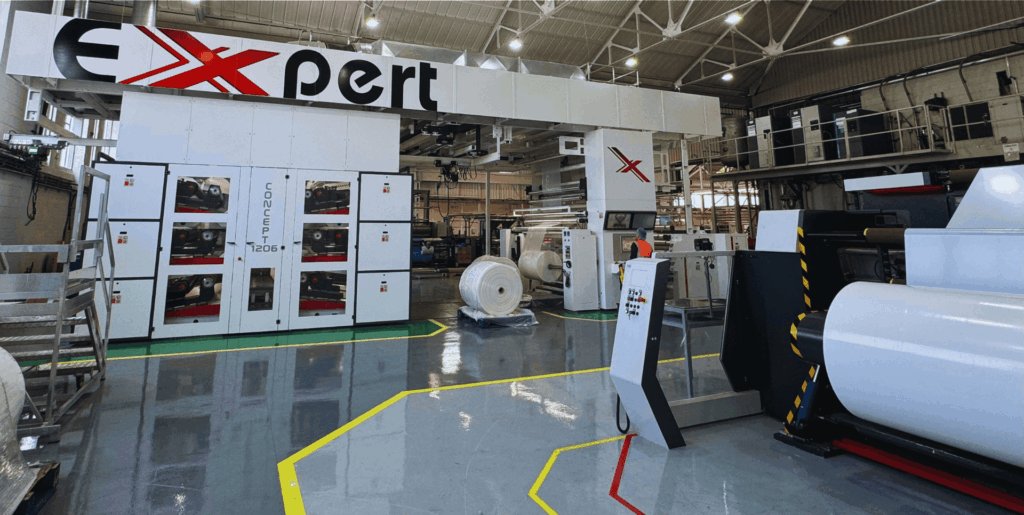
Most polythene packaging in the UK is printed on presses carrying between four and ten colour stations, and the number of colours you can use is set by how many stations the press has, not by how complex your design is.
At Polystar we print up to six colours in a single pass, at widths of up to 2300 mm, on film from 15 to 200 microns, at speeds of up to 300 metres per minute. Six colours covers the overwhelming majority of packaging artwork, including full-colour photographic images.
That is the headline. The useful part is understanding what a “colour” actually means on a packaging press, because it is not the same thing as a colour in a design file.
What a “colour” means on a print press
Open your artwork in design software and you might count fifteen or twenty distinct shades. On a print press, that number is irrelevant. What matters is how many inks are laid down, and each ink needs its own print station.
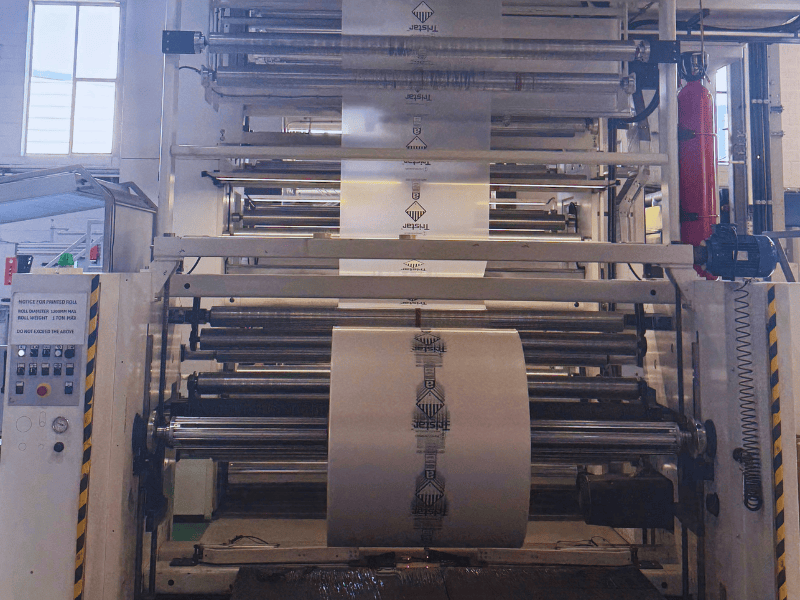
A six-colour press has six stations. The film passes through each one in turn, picking up one ink at a time, and the stations build the finished image in layers. If your design needs seven inks, it does not fit in a single pass. If it needs three, you use three stations and the rest sit idle.
So the real question is never “how many colours are in my design”. It is “how many inks does my design need”. Those are very different numbers, and the gap between them is where most of the cost sits.
Spot colours vs process colours
There are two ways to get colour onto polythene, and choosing the right one is the single biggest decision in a print specification.
Spot colour printing uses one ink per colour, mixed to match a specific reference (usually a Pantone). A logo in two Pantones plus black uses three stations. The colour is exactly what you specified, every run, because the ink itself is that colour.
Process colour printing uses four inks (cyan, magenta, yellow and black, or CMYK) overlaid in tiny dots to simulate a full spectrum. This is how photographs and gradients are reproduced. It uses four stations regardless of how many shades appear in the image.
On a six-station press you can run either approach, or combine them:
| Configuration | Stations used | Best for |
| Up to 6 spot colours | 6 | Bold logos, flat blocks of brand colour, precise Pantone matching |
| CMYK process only | 4 | Photographic images, gradients, complex illustration |
| CMYK plus 2 spot colours | 6 | Photography plus an exact brand colour or a solid background |
| CMYK plus white plus 1 spot | 6 | Photography on clear or coloured film |
That last row is the one people forget about.
Why white ink often costs you a station
Polythene is not paper. It is frequently clear, and where it is not clear it is often a strong colour: black, blue, white, or a house tint. Inks are translucent. Print a red onto a clear film and you get a red tint you can see straight through; print it onto a dark film and it may barely register at all.
The fix is a white underprint, sometimes called a white base, laid down first so the coloured inks have something opaque to sit on. It works well, but it consumes one of your stations. On a six-colour press, a photographic image on clear film that needs a white base is really CMYK plus white, which is five stations, leaving one spare.
This is worth knowing before you sign off artwork, not after. If you are printing onto clear or coloured film and your design already uses six inks, something has to give.
Why polythene needs treating before it will accept ink
Polythene has naturally low surface energy, which is a technical way of saying ink does not want to stick to it. Untreated polyethylene sits at roughly 31 dynes per centimetre, and printing inks generally need a surface at around 38 to 40 dynes per centimetre to bond reliably.
The gap is closed by corona treatment, an electrical surface treatment applied to the film that raises its surface energy so ink wets out and adheres properly instead of beading up or rubbing off. This is standard practice across the industry and it is why film supplied for printing is specified as “treated” on one or both sides.
One practical consequence: corona treatment decays over time. Film that has sat in a warehouse for a long period can drift below the required dyne level, which is one reason a manufacturer that extrudes and prints under one roof has an advantage over a supply chain that ships film between sites.
POLYSTAR INPUT NEEDED (1): Please confirm the standard dyne level Polystar treats to, and whether film is treated one side or both as standard. If there is a shelf-life guideline for treated film before printing, that would be a strong, genuinely useful detail here.
What else limits your colour options
Film thickness. Our presses handle 15 to 200 microns. Very thin films run at high tension and can be less forgiving on tight registration between stations, while heavier gauges are more stable. This rarely changes the number of colours available, but it does affect what fine detail is realistic.
Print width. We print up to 2300 mm wide, with the option of two-lane printing (running two separate images side by side across the web and slitting them apart afterwards). For high volumes of a smaller bag, two-lane printing is a meaningful efficiency gain.
Registration. Every extra station is another opportunity for the layers to drift out of alignment. Well-registered six-colour work is entirely routine, but designs that depend on hairline detail sitting perfectly between two inks are harder than designs built with a little tolerance.
Ink coverage. Heavy solid coverage across a wide web uses considerably more ink than a small logo. Coverage affects cost and drying, not station count.
POLYSTAR INPUT NEEDED (2): The site does not currently name the print process anywhere. Please confirm the process in writing so we can state it accurately. UK trade import records list flexographic printing machinery against Polystar Plastics, which points strongly one way, but a trade record is not a statement from you and we will not publish it as one.
POLYSTAR INPUT NEEDED (3): Ink system. Water-based, solvent-based, or both? This matters for food-contact and low-odour applications and is a common pre-sales question.
In-line and out-of-line printing
Printing can happen as part of the film conversion process (in-line) or as a separate pass on a dedicated press (out-of-line). Polystar does both, which means the right route can be chosen per job rather than forced by what the factory happens to own.
In-line tends to suit simpler print on high-volume, straightforward products. Out-of-line suits more demanding artwork and wider webs where print quality is the priority.
What we can print on
Print is not restricted to bags. Across the Polystar range we print:
- Mailing bags and mailing film
- Polythene bags
- Shrink and non-shrink pallet covers
- Collation shrink film
- Stretch hooding film
- Compression and flame retardant films
- Films and sheeting
Printed work also runs on our exclusive materials, including Tristar, Biofilm and PCWflex, so a move to a lighter or higher-recycled-content film does not mean giving up your branding.
POLYSTAR INPUT NEEDED (4): The content plan asks for two or three example sectors or brands we have printed for. Named customers are ideal for credibility. If names are commercially sensitive, unnamed sector examples (“a national insulation manufacturer”, “a UK subscription box brand”) still work well.
Frequently asked questions
How many colours can you print on a polythene bag? Up to six at Polystar, in a single pass. Six stations will cover full-colour photographic artwork (four process inks) plus two additional spot or white inks.
Can you match my exact brand colour?
Yes, using spot colour inks mixed to a Pantone reference. Bear in mind that the same ink looks different on clear film, white film and coloured film, so a printed sample on your actual substrate is always worth requesting.
Can you print photographs onto polythene?
Yes. Photographic images are reproduced using four process colours, often with a white base underneath if the film is clear or coloured.
Does printing add to lead time?
Printed work requires origination (preparing the printing plates from your artwork) before the first run. Repeat runs from existing plates are faster.
POLYSTAR INPUT NEEDED (5):
Origination and plate lead times, plate storage policy, and typical repeat-run lead time. Real numbers here are what turn this FAQ from generic into genuinely useful.
POLYSTAR INPUT NEEDED (6):
Minimum order quantity for printed work, and whether it differs between in-line and out-of-line. This is one of the most common questions a buyer has and the site does not answer it.
What artwork format do you need? Vector artwork with colours specified as Pantone references reproduces most reliably.
POLYSTAR INPUT NEEDED (7):
Confirm accepted file formats and any bleed or trapping requirements from your pre-press team, so we can replace the line above with your actual spec.
Talk to us about your print requirement
If you are working out whether your artwork fits a six-colour specification, or whether a white base is going to cost you a station, the fastest route is a conversation with someone who runs the presses.
Call 02380 232153 or send us your print enquiry.